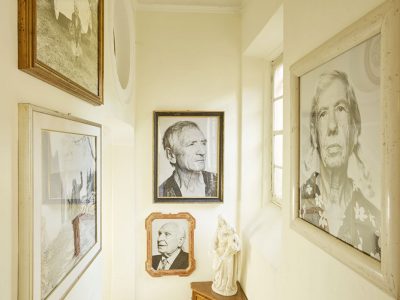
“Fuoco grande” is the title of the novel written together by Cesare Pavese and Bianca Garufi, left unfinished, which translates into narrative form the complexity of the human relationship between the two authors. Our room at Vigne di Fagnano takes its name from it, one of the many tributes that the owners, Carlo and Manila, pay to the writer who grew up just a few hills away, in a house similar to this one, where they moved in search of a more sustainable life. It takes only a few clues to understand that we have much in common with this place and its new “guardians.” First of all, the luminous melancholy that emanates from Cesare Pavese’s poetry. But also photography and design, the French-style vegetable garden, and Milo Manara’s comics. A reverence for details and for things of the past. Manila, the feminine soul of the house, appears in one of the rooms where I sit leafing through a book, carrying a tray of treats she has prepared; Carlo pours some wine and tells me its story. Everywhere there is space for a pile of books, a rare object, an analog portrait taken by Carlo, a photographer by passion, which is part of their private collection. Bodies, cities, streets. Scraps of their private history that come alive here in a different light. The truth is that Carlo and Manila do not simply welcome their guests: it is more accurate to say that they offer them unexpected gifts. From the bread that Manila kneads every day with sourdough starter and flours from the nearby Mulino Marino, to the 1973 issue of Playboy where, as Carlo points out, Pasolini wrote a wonderful article. Breakfast is a shared good morning among kindred spirits: a communal table set with genuine ingredients and care, next to the portraits of two ancestors of the Ravone Anfossi family, who lived within these walls for generations. Carlo tells us that in the other photo the same lady from the portrait appears as a student in front of the Université de la Sorbonne in Paris, where she had gone to study in the early twentieth century. The day continues with the visit of a village, a truffle-based lunch in one of the area’s restaurants, or with complete relaxation in the new spa set up within the cellar walls. In summer, with a dip in the pool bordered by rows of organic lavender. Lavender that, when we go to sleep, we find enclosed in a scented sachet between the sheets. It is yet another gift the couple gives us today, another story we did not know — that of the Langhe as a fertile cradle for the cultivation of medicinal herbs.
Words and photographs by Meraviglia Paper. Photographs of Il Diavolo sulle Colline and the courtyard by Alba Deangelis.